Overview
Multyx.io is a multiplayer game development platform that removes the hardest parts of networking and infrastructure. It combines a typed AST editor with ECS hosting on AWS and automated provisioning to help teams ship real-time games faster.
Links
- Live Product
- Private Repository
TL;DR
- Built a multiplayer game creation platform that hides networking and infrastructure work behind a typed AST editor and drag-and-drop components.
- Automated AWS provisioning with Step Functions + ECS so creators can deploy real-time prototypes without touching the console.
- Combined PostgreSQL, Redis, and WebSockets to keep project state, sessions, and instant testing responsive for beginner teams.
Context & Problem
Multiplayer developers regularly stall before gameplay iteration because networking, load management, and deployment pipelines consume the entire schedule. Early-stage teams without dedicated DevOps support abandon projects after wrestling with VPCs, sockets, and scaling policies. Multyx set out to remove that friction so beginners can validate ideas quickly while still landing on production-grade infrastructure.
Goals
- Shrink “time to first hosted build” from days of manual AWS setup to a guided flow that fits in one working session.
- Guarantee deterministic runtime behavior so gameplay logic cannot crash shared servers.
- Offer a zero-configuration test environment so non-networking engineers can iterate safely.
Solution Highlights
Typed AST editor for safe creativity
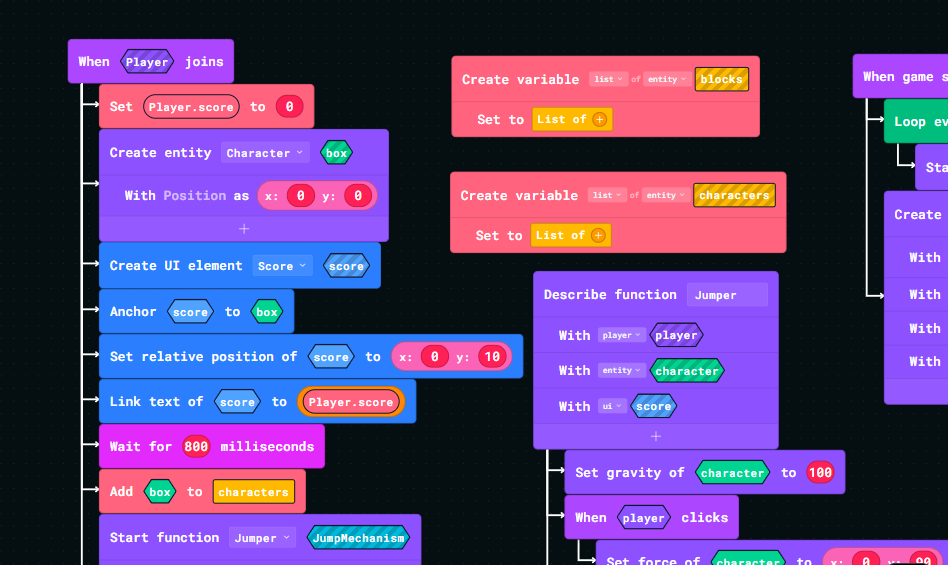
The in-browser editor compiles a typed AST for gameplay logic. Each node enforces allowed operations, which keeps the runtime predictable and makes it obvious where state lives. The drag-and-drop interface mirrors game engine thinking while emitting TypeScript that the platform can validate.
Automated AWS orchestration
Projects push through a Step Functions state machine that provisions ECS tasks, configures load balancers, and injects project-specific environment variables. Shipping a new multiplayer build is now a button press instead of a half-day IAM + CloudFormation chore. Docker images are stored once, then redeployed across isolated tenants for each team.
Developer-first DX
Live preview sessions stream via WebSockets so teams can test instantly; Redis tracks transient session data, while PostgreSQL stores persistent project assets and permissions. The dashboard surfaces deploy status, health checks, and log tails so beginners never need to open CloudWatch.
Architecture Snapshot
| Layer | Implementation |
|---|---|
| Frontend | TypeScript + Next.js UI with Tailwind for layout and component primitives. |
| Logic editor | Custom typed AST builder that emits validated gameplay code blocks. |
| API / Orchestration | Node.js services packaged in Docker, triggered by Step Functions to spin up ECS services per project. |
| Data | PostgreSQL for projects/assets, Redis for session + queue state. |
| Realtime | WebSockets broadcast live preview state back into the editor. |
| Hosting | AWS ECS/Fargate with automated scaling policies; deployments tracked in a private repo. |
Outcome
The platform now lets beginners ship real-time games without networking expertise while giving experienced teams a production-ready baseline from day one. Instead of spending the first sprint wiring VPCs and sockets, teams land their first hosted build through a guided wizard, then stay focused on gameplay iteration. The live product is available at https://multyx.io (codebase remains private).
Next Steps
- Expose opinionated starter templates (co-op shooter, turn-based tactics) to shorten onboarding even further.
- Layer lightweight analytics so creators can observe session health without leaving the dashboard.
- Expand the AST library with physics + economy components while keeping the runtime deterministic.